Learning From the Gardner Art Theft

Earlier this week, the F.B.I. announced that it had identified the two men who robbed the Isabella Stewart Gardner Museum in Boston in March 1990, in the biggest art theft in American history. The F.B.I. said the criminals, whom it did not identify, had most likely moved their loot to Connecticut or the Philadelphia area.

Twenty-three years may seem like an inordinate amount of time to solve a burglary, but the Gardner case has actually come a long way from the days when it sometimes seemed to sit on the F.B.I.’s investigative back burner — and the robbery has done a lot to change the way that museums protect their art. 

The robbery occurred just after midnight on March 18, 1990, when two men dressed as police officers appeared at the side entrance to the museum. There had been “a disturbance on the grounds,” the men told the night guard through an intercom. 

One of the guards buzzed the men into the building, and after tying up the two watchmen, the thieves essentially had the run of one of the world’s most beautiful museums for more than an hour. Mrs. Gardner, the art collector and philanthropist who founded the institution, was devoted to the idea that art was powerfully redemptive, and she built intimate galleries to showcase her collection. She felt so strongly about the museum that in her will she insisted that nothing be changed in the galleries, not even the plaster cast of the composer Franz Liszt’s hand. Today the galleries are arranged just as they were when Mrs. Gardner died, in 1924. 

"La Gitana"
On that evening, the thieves moved through the narrow hallways, past the Han dynasty bears and Louis Kronberg’s oil painting “La Gitana.” They ignored the 18th-century Indian bookstand and the 15th-century Italian fresco of Hercules.
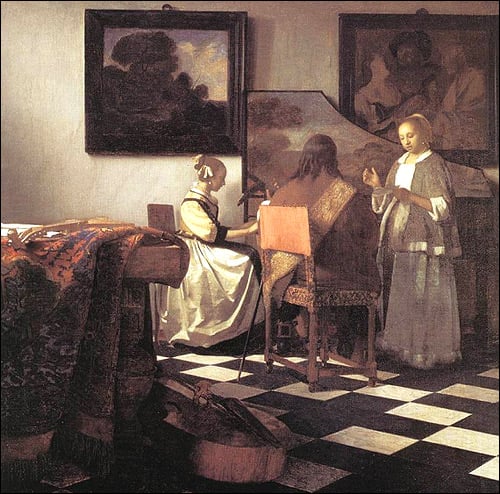
"Concert"
They went for some of the museum’s crown jewels, snagging Vermeer’s “Concert” along with three Rembrandts, a Manet and a Degas. The two thieves didn’t seem to be particularly respectful toward art — they sliced two of the Rembrandts out of their frames — but they did manage to sneak away with a haul worth as much as $500 million today. 

Over the years, it hasn’t seemed as if federal investigators have always made the case a top priority. When I first started reporting on the theft, for instance, the museum’s director, Anne Hawley, suggested that she had not always been satisfied with the bureau’s commitment to the case. Ms. Hawley, the director since 1989, said that the first agent assigned to the case seemed very green. “Why didn’t the F.B.I. have the capacity to assign a senior-level person?” she asked me in 2007. “Why was it not considered something that needed immediate and high-level attention?”
When the theft occurred, the museum’s security was lax by today’s standards. While the Gardner’s protections were not particularly bad for a modest-size house museum at that time, one of the guards who worked the night of the theft later admitted to having smoked marijuana before arriving for work. The museum also lacked theft insurance, which prevented it from offering a major reward immediately after the burglary. 

But these problems were not limited to the Gardner. The idea that art theft is not quite a serious crime has a strange hold in some quarters. Over the years, the F.B.I.’s prioritization of terrorism after 9/11, not to mention numerous violent crimes, also may help account for the length of the investigation. But when crooks steal masterpieces, they steal part of our culture and civilization. 

You can replace a wallet, an iPod, even a diamond necklace, but not a Rembrandt. The art world knows this. The Gardner offered a $1 million reward a few days after the theft occurred, and in 1997, it raised the reward to $5 million, believed to be the largest ever offered by a private institution. A few years ago, the museum also brought in a new head of security, Anthony Amore, who has become obsessed with the case. He keeps an electronic copy of his investigation files with him at all times, even outside of work. 

Museum security has changed too. The Gardner has significantly upgraded its protections, and because of the theft, the American Association of Museums revamped its guidelines, recommending that institutions be more careful about whom they let in after hours. In 1994, at the museum’s urging, Senator Edward M. Kennedy helped pass a law that made it a federal crime to steal, receive or dispose of any cultural object worth more than $100,000. 

The statute of limitations for breaking into the museum has expired, but prosecutors could potentially use the 1994 law to convict someone for possession of the stolen art today. (That said, the museum’s top priority is recovering the art.) 

The F.B.I. has also significantly ramped up its efforts to recover stolen art. In 2004, the agency created a national art theft team, which has more than a dozen agents assigned to regions across the country. The bureau also has two agents working on the Gardner case, and last year, they made a high-profile raid on the house of a Connecticut mobster. Since the announcement on Monday, and the increased attention on an F.B.I. Web site devoted to the Gardner theft, tips and new leads have been pouring in. 

As for the men who robbed the museum, there’s been some good evidence over the years regarding their identities. In my book on the theft, I pointed the finger at the Boston mobster David Turner. As part of my reporting, I examined F.B.I. files that indicated that Mr. Turner was an early suspect, and he bears a strong resemblance to the composite drawing made of one of the thieves. In a letter to me, Mr. Turner denied any role in the theft, but he also told me that if I were to put his picture on my book’s cover, I would sell more copies. 

More important, there are signs that the paintings may hang on the walls of the museum again. At the news conference on Monday, the F.B.I. announced that in the years after the theft, someone took the stolen Gardner art to Connecticut and Philadelphia and offered it up for sale. This suggests that the canvases might still be in good condition. 

“I think we’re all optimistic that one day soon the paintings would be returned to their rightful place,” the United States attorney for Massachusetts, Carmen Ortiz, said. Let’s hope she’s right.

Ulrich Boser, a senior fellow at the Center for American Progress, is the author of “The Gardner Heist: The True Story of the World’s Largest Unsolved Art Theft.”

Ulrich Boser, a senior fellow at the Center for American Progress, is the author of “The Gardner Heist: The True Story of the World’s Largest Unsolved Art Theft.”

The dark arts of art forgery

By Jordan Green
art1813794

Those who investigate art fakes, forgeries and fabrications operate in a realm where – similar to espionage and counterintelligence – a certain degree of paranoia is healthy.

James Martin, a trained painter who has studied art history and chemistry to become a consultant in demand by both the FBI and a number of prominent art museums, began his talk on forensic art history at Reynolda House Museum of American Art on Sunday by asking if there were any artists in the audience. Then, he asked if there were any attorneys present. There were a couple.

“Attorneys working for parties adverse to me?” he asked. One senses that this guy has accumulated some enemies. “Any experts on faked and forged artwork?” he asked. “Any producers of faked or forged artwork?” Martin noted that materials such as Phillips-head screws (developed in 1936) and polypropylene paint (invented in 1958) can establish a fake if the original artwork dates back to an earlier period. After describing how some people harvest the powder inside fluorescent tube lamps, mix it with varnish and apply it to the surface of paintings to defeat an ultraviolet examination, he half-joked, “I’m giving tips to forgers, but only because you’ve told me there are none in the audience.”

And similar to the burgeoning industry of cyber-security where the best in the business hold some experience in hacking, the best artfraud detectives hold the same skill sets as the fraudsters.
“Before I studied chemistry and art history, I studied art,” Martin said.

“And one of the things I did was to copy the old masters. And I’m really, really good at that. Which makes me really good at catching people who fake paintings, too.”

Martin described scholarly art authentication “as like a three-legged stool” that relies on connoisseurship, provenance — defined as the documented history of the art — and testing, which includes “technical examination and scientific testing.”

The audience of upwards of 50, including members and guests of the museum, ate it up.

Martin’s firm, Orion Analytical, owns a Raman microscope worth more than most cars that can analyze a speck that is a thousandth of a millimeter. He worked on an investigation that determined a purported Jackson Pollock painting purchased by a hedge-fund investor for $17 million was, in fact, a fake.

Art forgers can go to extraordinary and creative lengths to perpetrate hoaxes. Martin laid out the scenario of a forger intent on defeating a thermo-luminescence dating process by collecting bricks from a 1000 AD Chinese archeological site to assemble a fake antiquity dog sculpture. The forger might grind up one of the bricks, mix the powder with Elmer’s glue and smear it over the surface to cover the joins.

“So if you took a sample of this and submitted it for thermoluminescence dating, it would tell you that the brick, or that the ceramic, was a thousand years old,” Martin said. “But it wouldn’t tell you that the dog was created about five years ago. So one of the first things we do is put a drop of solvent on it to look for the Elmer’s glue.”

Then there’s the real-life case of Wolfgang Beltracchi, a German forger who created an entire fake collection purported to be assembled by the late art collector Werner Jaeger. The scheme, which Martin helped bring down, involved Beltracchi posing his wife in period clothing as the Jaeger matriarch with the paintings in the background to make it appear as though the collection had been in existence in the 1920s.

Similarly, John Drewe, working with forger John Myatt, created false exhibition catalogues that he planted in the research library at the Tate Modern museum in London to create a fraudulent provenance for the purpose of throwing off investigators.

But art criminals, like all criminals, make dumb mistakes. Case in point: William Toye, who faked the paintings of Clementine Hunter, a 20th century Louisiana folk artist whose paintings have appreciated from about $10 to about $10,000.

“Toye loved cats,” Martin said. “He had lots of cats. And his cats had a habit of standing on the table where he made all of his fakes. So, as you might suspect, every one of his fakes had cat hair embedded.”

Dreams and Reality


“All that we see or seem / Is but a dream within a dream.” -- Edgar Allan Poe

Art often addresses the relationship between dreams and reality, and in the photographic works of Luis Beltrán (b. 1973) visions and dreams become the reality. While a train’s travel may be confined to its track, Beltrán’s images are limited only by the imagination.

Based in Valencia, Spain, Beltrán specializes in digital art, photo manipulation, and photo illustration. His poetic, often fantastic imagery and incongruous juxtapositions transport the viewer to the place where dreams come alive and the unexpected is the status quo.

Quaba
Photographic Print, By Luis Beltrán

X-Ray Photos


X-ray of skull with gearsWhile most photographs capture what the eye beholds, x-ray photography reveals the beauty within or, with a little manipulation, a conceptual look at what lies beneath the surface, like photographer Thom Lang’s combination of an “X-ray of s...kull with gears”. (

Many photographers are turning to x-ray imaging to explore the internal beauty of the world around us, and the results are extraordinary. Thom Lang explores intriguing connections and juxtapositions by combining objects with existing x-rays, while others take a more bare bones approach to proving that beauty is more than skin deep.

Rogues’ Gallery: ‘The Art Forger,’ by B. A. Shapiro 

By  

Illustration by Leslie Herman

HE ART FORGER

By B. A. Shapiro
360 pp. Algonquin Books of Chapel Hill. $23.95.
 
Isabella Stewart Gardner was decidedly eccentric. She walked lions, not dogs; drank beer, not sherry; and bathed opposite improving maxims rather than wallpaper patterns. (Some were more ominous than others: “Secret of two, secret of God; secret of three, secret of all.”) Such behavior made her reputation, though it was her magnificent art collection, assembled with the help of the young Bernard Berenson, that won her lasting fame. In 1903, Gardner opened her Venetian-style gallery — then called Fenway Court — to the city of Boston, enriching generations to come.
Today, alas, her name is associated with less savory exploits. In March 1990, two men dressed as police officers looted 13 works from her museum, including Rembrandt’s only recorded seascape, Vermeer’s “Concert” and several lesser sketches by Degas. B. A. Shapiro’s nimble mystery “The Art Forger” revisits this unsolved theft when, more than two decades on, one of Gardner’s paintings seems to resurface.
Shapiro’s present-day heroine, Claire Roth, typifies the fictional artist: attractive but disheveled, talented yet struggling. It’s Claire’s sideline that distinguishes her. To pay the bills, she paints commissioned reproductions, mostly after Impressionist models. (These are, she tells herself, copies that simulate the originals, not forgeries.) At 31, despite her raffish allure, Claire spends lonely nights on the floor-hugging mattress she’s occupied since breaking up with her boyfriend and fellow artist, Isaac Cullion, who has since died.
Enter Isaac’s former dealer, Aiden Markel, with an intriguing offer: copy an undisclosed picture and Claire will receive much-needed cash and her own one-woman show at his trendy gallery. The painting in question? On arrival, it bears an uncanny resemblance to a Degas masterpiece stolen from the Gardner Museum. (Titled “After the Bath,” the work is Shapiro’s invention, based on four related canvases of the 1890s.) Is it the lost original? Has Claire been asked to copy or to forge? Does it matter?

Shapiro’s brisk narrative takes the reader through Boston’s art world, the logistics of forgery and the perils of attribution, shuttling between the present and three years earlier, when Claire lost Isaac and first straddled the line between copying and fraud. Interwoven are letters from Gardner to a fictitious niece, Amelia, tracing the obscure circumstances under which she acquired the Degas. (The real-life Gardner burned all her correspondence. If, as in Shapiro’s imagining, she acknowledged replies with “Thanksissimo,” perhaps it’s just as well.)

Shapiro writes with assurance, even if she stumbles over the odd phrase or detail. Never mind that Jean-Louis-Ernest Meissonier, whose painting is scrubbed clean for Claire’s “Degas,” was one of the most celebrated artists of his day; nor that Bernard Berenson, Gardner’s adviser and agent (not “dealer”), whom Sha­piro’s fictional curator invokes as the last word, was fallible, some of his authentications for Joseph Duveen having later proved unsound. A few plot threads are slenderer than others, including Claire’s volunteerism and the baldly expository diary of Amelia’s artist beau, Virgil. Sha­piro’s art world blather may verge on caricature: “He’s working with cobblestones. Very ingenious.” Sadly it’s not entirely inaccurate.

For those willing to forgive the occasional misstep, “The Art Forger” will reward their forbearance and, through its engaging premise, their intelligence. Is black-and-white authenticity paramount or are there acceptable degrees of attribution? Aiden and Isaac see subtler shades; Claire isn’t so sure. In the end, with plots uncovered and deceptions laid bare, Shapiro’s abiding mystery lies not in the act of forgery itself but in its elusive morality. As Claire reminds us, people see “what they want to see.”

Maxwell Carter is an associate vice president and a specialist in Impressionist and modern art at Christie’s.